
An American in Thailand: My Journey as an IIE NextGen Fellow

Ever wonder what it’s like to work as an international scientist? Hi my name is Hannah Kern and this has been my journey working as an American in Thailand as a NextGen Fellow with the Institute of International Education or IIE NextGen Fellow.

Let's first start out with who I am and what it means to be an international scientist. This past May, I graduated with my Bachelor’s of Science in Environmental and Natural Resources with dual minors in Biological Sciences and Sustainability. In addition to my degree, I am also in the process of completing a certification in Emergency Management.
That being said, in my experience academics does not make you a scientist, let alone one who works abroad. What truly drives scientific innovation is a curious mind, and curiosity comes in all forms. Working internationally strengthens curiosity as collaborating with others opens your mind.
Throughout the world many people ask the same simple question of “why?” or “how can I make my environment better?”. The sharing of ideas can often lead to these simple core questions, and I am lucky enough to have the opportunity to work in these spaces to facilitate discussions.

The ability to facilitate discussion and communication across sectors can be extremely difficult, and the organization that I have worked with for the past several weeks excels at it. I have been working with the Scholars of Sustenance Foundation Thailand (SOS Thailand) in their Chiang Mai office in northern Thailand.

This organization works all across Thailand, Indonesia, and the Philippines coordinating with hundreds of volunteers. What makes this non-profit unique is how it operates across industries.
The overall goal of this charity is to prevent food waste. But what does that actually mean? These workers take food that often is about to expire, cannot be sold, or would be thrown away otherwise and redistributed to those in need. Some of the recipients of our food that I have worked with include schools, orphanages, hospitals, and food banks.

While this non-profit works in food, many people often underestimate just how many sectors the food industry has. My work has had aspects of corporate sustainability work as I have collaborated with multi-billion dollar corporations and given them reports back. I have also worked with professors who work in research and food testing.
This organization performs food safety testing to ensure quality, and hosts community kitchen days to cook and serve meals to those in need. In addition to all that, they also work with farmers to receive food and then reach out and coordinate with those who need to pick up food.
This small staff works hard to coordinate and ensure communication across all these sectors to ensure daily operation and make the world a better place.

Throughout this experience the number one thing that I would emphasize to others is adaptability. Working in sustainability, it is common for no two days to look the same, and this can be intensified when working abroad. Navigating language barriers, different customs, and various ways of life can add to the craziness of operating in this industry.
However this adaptability makes you, the communities you work in, and the world stronger. Each sector of each industry in the world has their own customs, superstitions, and a different “normal”. Facilitation across industries is beneficial, but can be disastrous if one is not prepared to meet people where they are at. By meeting people where they are at you can work with them as a colleague rather than a lecturer and positive change can happen.
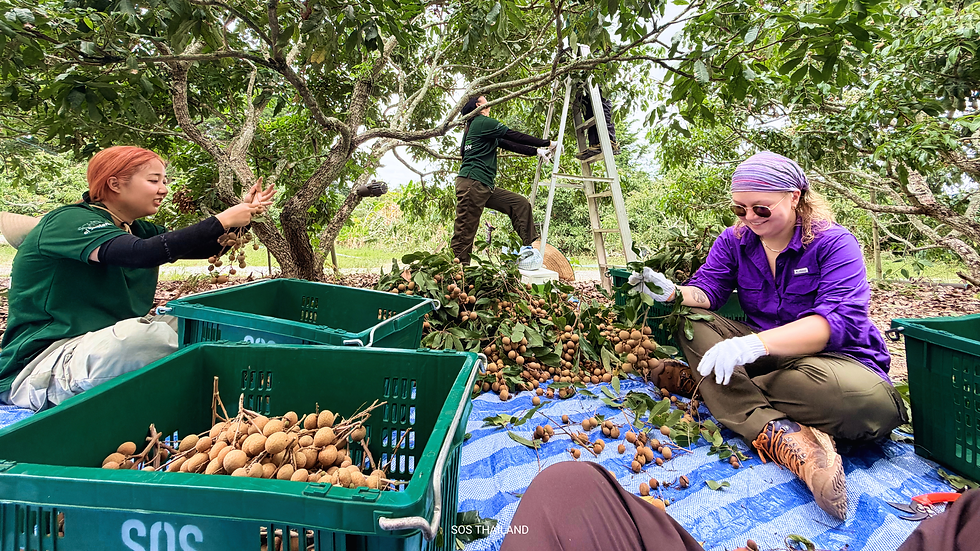
To encourage positive change you must reflect and be adaptable. If you are adaptable, then you too can contribute to scientific communication across the globe.
By Hannah Kern, SOS Thailand Internship
Produced by SOS Thailand
30 October 2026, Chiang Mai, Thailand


Comments